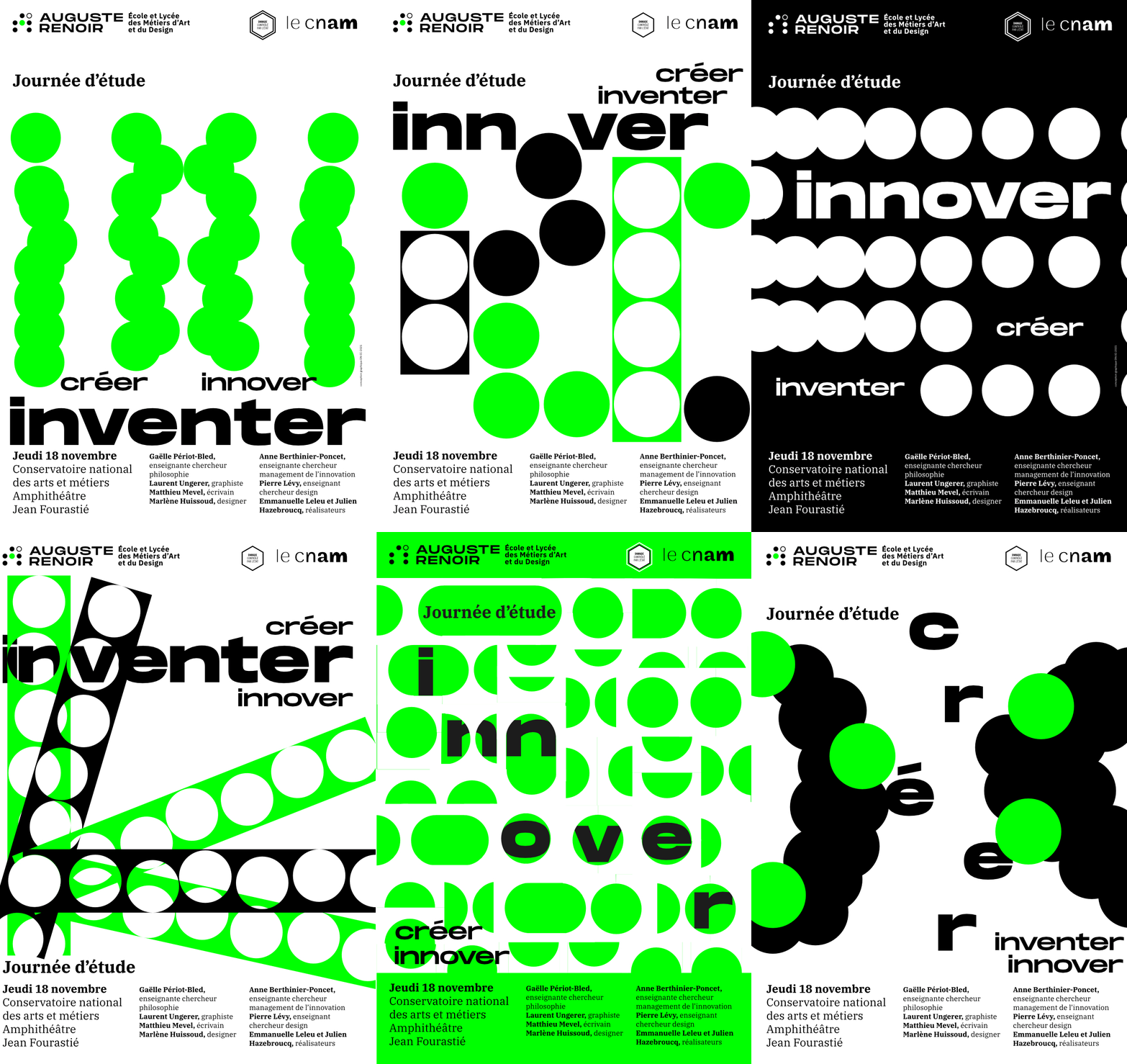
Between methods and practices in design - a learning moment
Pierre Lévy, professor at CNAM, Jean Prouvé Chair of Design
Today I would like to focus on the place of methods and practices in design, and to describe their in-between as a place of practice development, that is, as a moment of reflexive learning about practice.
1. Design
The first point of attention concerns the very notion of design and the way it is described by the design research community itself. A recent paper (Blackler et al., 2021) proposes an analysis of twenty years of discussion on one of the most active and renowned mailing lists in the world (PHD-DESIGN List, n.d.) concerning the definition of design. Its conclusion is as follows: Despite a robust discourse around relevant perspectives on design, the list discussions are and have been repetitive, with no significant progress towards a consolidated definition of design. […] We propose that it may not be possible to define design in this way, and that the field should move away from reiteration and discuss the importance of the role of design… (Blackler et al., 2021)
We can already note that the attempt to define design seems inconclusive, and the authors of the paper suggest that this attempt is inevitably doomed to never succeed. Design cannot be defined and it is time to move on: instead of questioning what design is (description of state), it seems more judicious to question the role of design (description of action).
Design’s resistance to definition also seems to be expressed by Johan Redström (2017) when he addresses the foundations of design: Design seems to base its existence on complexities arising from dichotomies. To negotiate form and function. To engage craft and its skills, and to work with industrial production. To work with open processes and to be deeply committed to method. To be user-centered and design-driven. To be art and science. […] And design can also be remarkably resilient and willing to engage with all of this, which is neither black or white, but complex and colorful. […] The reason we so appreciate dichotomies in design is because it allows us to address conflict, collision, and contradictions, and thus open up new perspectives and potentials.
What Redström tells us is that we can find the strength of design (some say the power of design, we will say its capacity for action) within dichotomies. It is indeed in collision, contradiction or irregularity (Lévy, 2018, 2019) that new opportunities are created and transformations become possible. In a common and global understanding, that is, without friction, transformation is far less likely.
The first conclusion is therefore: Design is elusive, and that is rather good news! Reflexive practice as well as the acceptance of multiple perspectives and dichotomies thus seem relevant for design.
2. Methods and activities
Methods in design are essential for the formalization of design processes. They are therefore important in teaching since they allow clarifying a framework for the project and for the learner to grasp the complexities previously discussed. They are important in professional practice both for project management and for the communication of and around the project.
However, existing methods, and we take here as examples the double diamond proposed by the Design Council (2019) and the MV Model proposed by Kees Dorst (2015), seem to focus on an ordered sequence of predefined activities, a sequence often contradicted by practice.
Practice can be more faithfully described by the situated actions that constitute it. This is what the Reflective Transformative Design Process (C. Hummels & Frens, 2009) proposes, offering an effective perspective both for design practice itself and for its teaching. The description of activities allows framing practice without imposing an out-of-context order. Experience indeed shows that the project must adapt to accessible resources and to the constraints and opportunities that arise.
Moreover, at a time when design is increasingly investing in the social and political arena, we have developed a new approach, transformative practices (C. C. M. Hummels et al., 2019), which precisely takes up this idea of discussing practice through activities while including notions related to social participation and complexity, among others.
These approaches prescribe neither sequence nor real limits to activities, so that the practice thus described may appear both deconstructed and omnipotent. But it is precisely through one of the dichotomies proposed by Redström - working with open processes and being deeply committed to method - which exposes the strength of the contradictory association formed by method and practice, that of a reflexive activity made possible by the delta between practice and methods, which precisely invites a transformative, and therefore learning, reflection on design practice.
This is therefore the second conclusion of my presentation today: Methods and activities form a dichotomy in design. It is through this dichotomy that design practice establishes itself, through a transformative and learning reflection on practice.
Bibliography
Blackler, A., Swann, L., Chamorro-Koc, M., Mohotti, W. A., Balasubramaniam, T., & Nayak, R. (2021). Can We Define Design? Analyzing Twenty Years of Debate on a Large Email Discussion List. She Ji: The Journal of Design, Economics, and Innovation, 7(1), 41-70. https://doi.org/10.1016/j.sheji.2020.11.004
Design Council. (2019). What is the framework for innovation? Design Council’s evolved Double Diamond. Design Council. https://www.designcouncil.org.uk/news-opinion/what-framework-innovation-design-councils-evolved-double-diamond
Dorst, K. (2015). Frame Innovation: Create New Thinking by Design. MIT Press.
Hummels, C. C. M., Trotto, A., Peeters, J. P. A., Levy, P., Alves Lino, J., & Klooster, S. (2019). Design research and innovation framework for transformative practices. In Strategy for change (pp. 52-76). Glasgow Caledonian University.
Hummels, C., & Frens, J. (2009). The reflective transformative design process. Proceedings of the 27th International Conference - Extended Abstracts on Human Factors in Computing Systems CHI09, 2655-2658. https://doi.org/10.1145/1520340.1520376
Lévy, P. (2018). Le temps de l’expérience, enchanter le quotidien par le design [Habilitation à diriger des recherches]. Université de Technologie de Compiègne, France.
Lévy, P. (2019). Designing for the everyday through thusness and irregularity. Proceedings of the International Association of Societies of Design Research Conference 2019, IASDR19. International Association of Societies of Design Research Conference 2019, Manchester, UK.
PHD-DESIGN List. (n.d.). Retrieved 4 December 2021, from https://www.jiscmail.ac.uk/cgi-bin/webadmin?A0=PHD-DESIGN
Redström, J. (2017). Making design theory. MIT Press.